 English



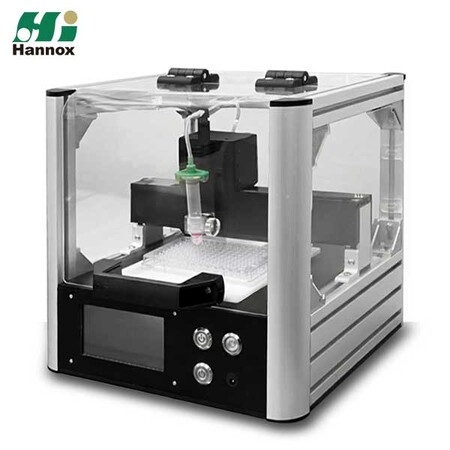


Automatic Cell Microplate Dispenser
ACD-2496
Purpose-built for 6- to 96-well microplates, this automated cell dispenser delivers faster, more precise, and labor-saving operation over manual pipetting. Compared with conventional peristaltic pumps, it minimizes dead volume, ensures gentle cell handling to preserve viability, and provides superior dispensing consistency.
Cell Dispensing System
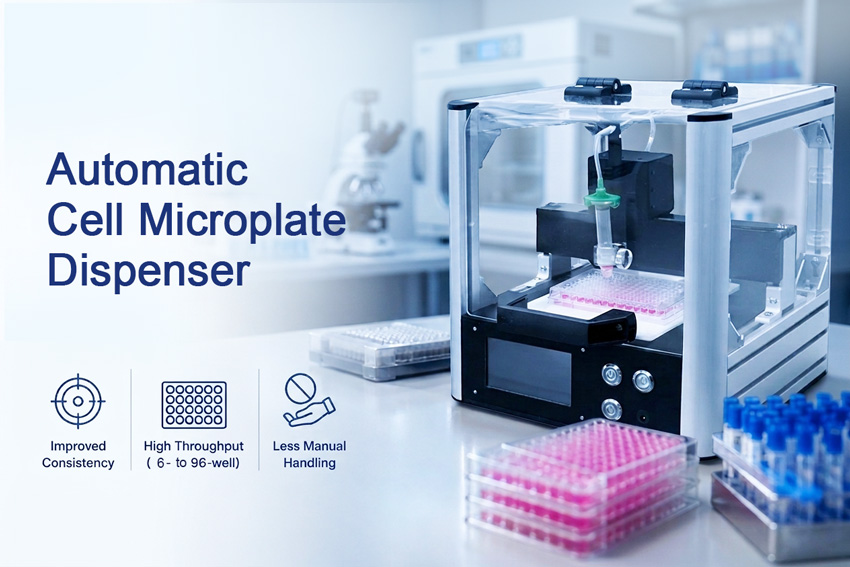
More Consistent Cell Dispensing with Less Manual Handling
Manual cell dispensing can introduce well-to-well variation, especially when many wells must be prepared in the same experiment. The Automatic Cell Microplate Dispenser standardizes this step by dispensing cell suspensions automatically into 6- to 96-well plates. The result is a more controlled workflow with better consistency than repetitive manual pipetting.
Gentle Handling for Cell-Based Research
The dispensing approach is designed to minimize unnecessary mechanical stress on cells. This makes the system well suited to workflows in which cell integrity, viability, and reproducible seeding are important experimental variables. Users can preset both the desired cell quantity and the volume of culture medium.
KEY FEATURE
Programmable Droplet Dispensing (25–100 µL)
Dispenses programmable droplets from 25 to 100 µL into 6- to 96-well microplates, with a maximum operating volume of 5 mL.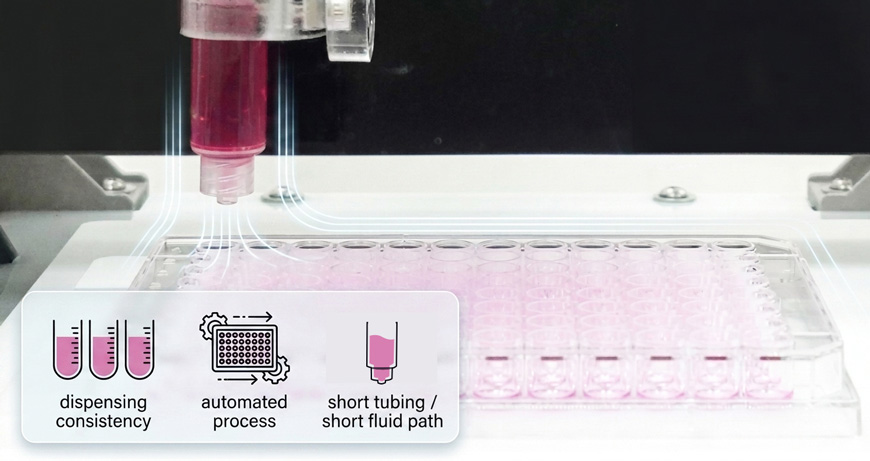
Anti-Sedimentation Agitation
Uses programmable rocking to keep cells in suspension throughout the run, minimizing cell settling and maintaining uniform plating density across wells.Dead Volume of 500 µL
Short fluidic pathways maintain dead volume at 500 µL, reducing sample loss for low-volume or high-value cell preparations.Low-Shear Fluid Handling
Applies lower shear stress than standard peristaltic pumps and manual pipetting, reducing mechanical damage to cells.Healthy Cell Growth After Dispensing
In internal testing, dispensed SH-SY5Y cells attached evenly across wells, and PLC5 cells showed normal proliferation over 5 days.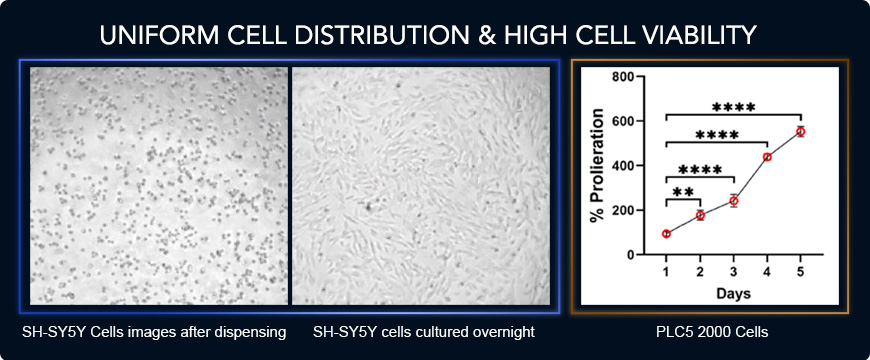
Volumetric Precision (CV ≤ 5%)
Achieves well-to-well repeatability with CV ≤ 5%, reducing manual pipetting errors and inter-operator variation across multi-plate preparations.Biosafety Cabinet (BSC) Compatibility
Compact design fits inside standard Class II BSCs designed to minimize disruption to laminar airflow, supporting aseptic workflows.With the ISO12100:2010, EN60204-1:2018 Certificate

APPLICATION

Cell Therapy and Advanced Cell Research
Supports standardized preparation of multiwell plates for cell therapy development and other cell-based research where consistent cell distribution is important.

Biopharmaceutical R&D and Cell-Based Assays
Useful for plate-based experiments that require repeatable cell seeding before screening, culture, treatment, imaging, or other downstream analysis.

CDMO and Multi-Project Laboratory Workflows
Automation can reduce repetitive manual work and improve consistency across operators, making the system attractive for development laboratories and CDMO environments handling multiple cell-based projects.

Precious or Limited Cell Samples
The low-residue fluid path is particularly relevant when only a small amount of cell suspension is available or when sample conservation is a priority.
SPECIFICATION
| Item | Specification |
|---|---|
| Dimension | 341 x 300 x 330 (mm) |
| Work area | 100 x 150 (mm) |
| Input voltage | DC 12V / 2A |
| Compatibility | 6 / 12 / 24 / 48 / 96-well plates |
| Power adapter | AC 100~240V |
| Material | Aluminum / Stainless steel / Acrylic / Plastic |
| Operation method | Touch control interface / button |
| Vibration freq. (cpm) | 0~90 |
| Swing angle (degree) | 0~90 (Volume and bubble must not exceed the maximum line) |
| Droplet size | Adjustable based on requirements (Recommended drip volume range: 25-100 µL) |
| Consumables | Sterilized dedicated tubes (PP material) and rear-end tubing components |
Cell Isolation and Operation Technologies: Comprehensive Comparison Table
| Feature | Manual Multichannel Pipette | Bulk Reagent Dispenser | Automated Cell Microplate Dispenser |
|---|---|---|---|
| Primary Design Intent | General liquid transfer | High-throughput buffer/reagent loading | Aseptic live-cell aliquoting |
| Dead Volume | Variable | High (often > 2–5 mL) | Low (0.5 mL) |
| Anti-Sedimentation | None | None | Yes |
| Stress on Cells | Variable | High | Low |
| Volumetric Precision | CV 3–8% | CV ≤ 2–5% | CV ≤ 5% |
| Inter-Operator Drift | High | Low | Low |
| Operation Time | Long | Short | Short |
DIRECTION FOR USE
A typical research workflow is outlined below. Exact settings should be established for the cell type, concentration, medium, and study protocol.
- Prepare a well-dispersed cell suspension according to the laboratory protocol and confirm that the suspension is suitable for dispensing.
- Select the required 6-, 12-, 24-, 48-, and/or 96-well plate and place the plate in the designated dispensing position.
- Load the cell suspension and install the appropriate fluid path or dispensing accessories according to the system setup.
- Set the dispensing parameters required for the experiment.
- Start the automated dispensing cycle and allow the system to complete plate filling.
- Inspect the plate and cell distribution as required by the study protocol before proceeding to culture or downstream analysis.
- After use, follow the laboratory-approved cleaning, decontamination, or consumable-replacement procedure.
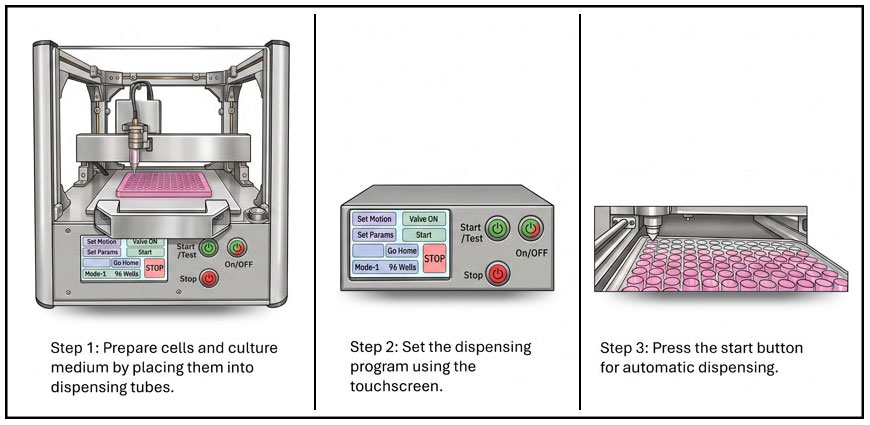
Note: Cell viability and dispensing performance can vary with cell size, concentration, aggregation tendency, medium viscosity, and selected operating parameters.
FAQ
| 1. How does this dispenser differ from a manual multichannel pipette? Unlike manual pipetting, which is prone to operator fatigue and cell settling in open reservoirs, this dispenser provides continuous anti-sedimentation rocking and automates 96-well seeding in under3 minutes. |
| 2. How does it differ from a bulk reagent dispenser? Bulk dispensers generally require large priming volumes (>2–5 mL) and generate high shear stress with peristaltic rollers. This system features a low dead volume of 500 µL and low-shear fluidics to protect live cells. |
| 3. How does the system prevent cell sedimentation? Its programmable rocking mechanism continuously agitates the suspension during the run, ensuring uniform cell density from the first well to the last. |
| 4. What is the dead volume and sample capacity? Short fluidic pathways limit residual dead volume to 500 µL, with a maximum operating volume of 5 mL. |
| 5. What is the dispensing volume range and speed? It delivers programmable droplet volumes from 25 to 100 µL and completes an entire 96-well plate in under 3 minutes. |
| 6. What is the volumetric precision? Volumetric repeatability is CV ≤ 5%. |
| 7. Does the dispensing process damage cells? The low-shear fluid path is designed to minimize mechanical stress on cells. In internal testing, dispensed cells attached evenly and proliferated normally. |
| 8. Which plate formats are compatible? It supports programmable aliquoting into standard 6-, 12-, 24-, 48-, and 96-well microplates. |
| 9. Can the unit be placed inside a Biosafety Cabinet (BSC)? Yes. Its 27L footprint fits inside standard Class II BSCs and is designed to minimize disruption to laminar airflow. |
| 10. Why is it suitable for high-value or primary cells? The combination of low dead volume (500 µL), gentle handling, and small operating batches (up to 5 mL) minimizes costly cell loss. |
| 11. Is this system intended for clinical diagnosis? The system is intended for cell research and development workflows only. Any clinical or diagnostic use would require separate confirmation of the applicable regulatory status. |
| 12. Can the same settings be used for every cell type? Not necessarily. Cell size, concentration, aggregation tendency, medium composition, and viscosity can affect dispensing behavior. Parameters should be optimized and verified for each application. |

Welcome Private Label, OEM/ODM, Distribution, and Agency Partnerships
For any further question ( Minimum Order Quantity, Prices or Domestic Distributor), please fill out the inquiry form, we will get back to you as soon as possible. Let us work together to make your product come true and hit the market successfully.
- Related Products
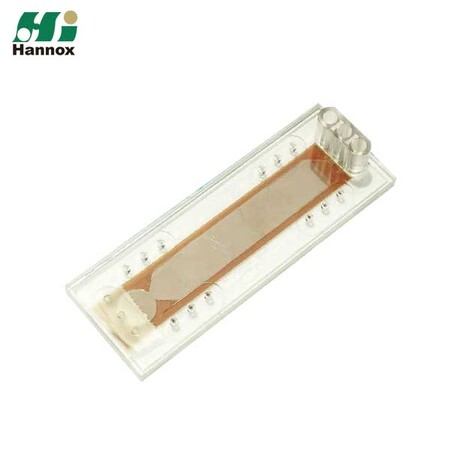
Microfluidic Cell Sorting Chip
MCS-96
Microfluidic simple cell isolation chip for direct isolation into 96-well plates, immediate microscopic verification, and rapid transition from isolation to incubation.
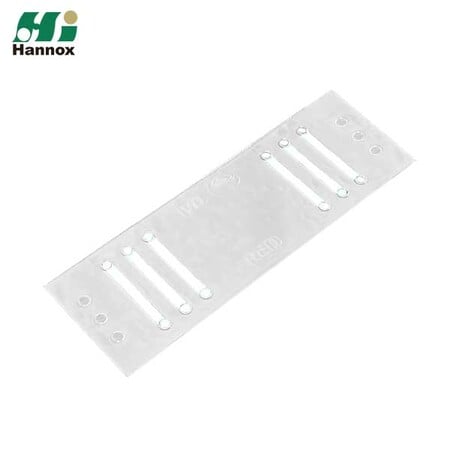
Live-Cell Fluorescence Imaging Chip
CIC-6F
Six-channel microfluidic imaging chip can use with a 170 µm optical bottom for confocal fluorescence microscopy, live-cell observation, blood cells, and micro-volume samples operation.